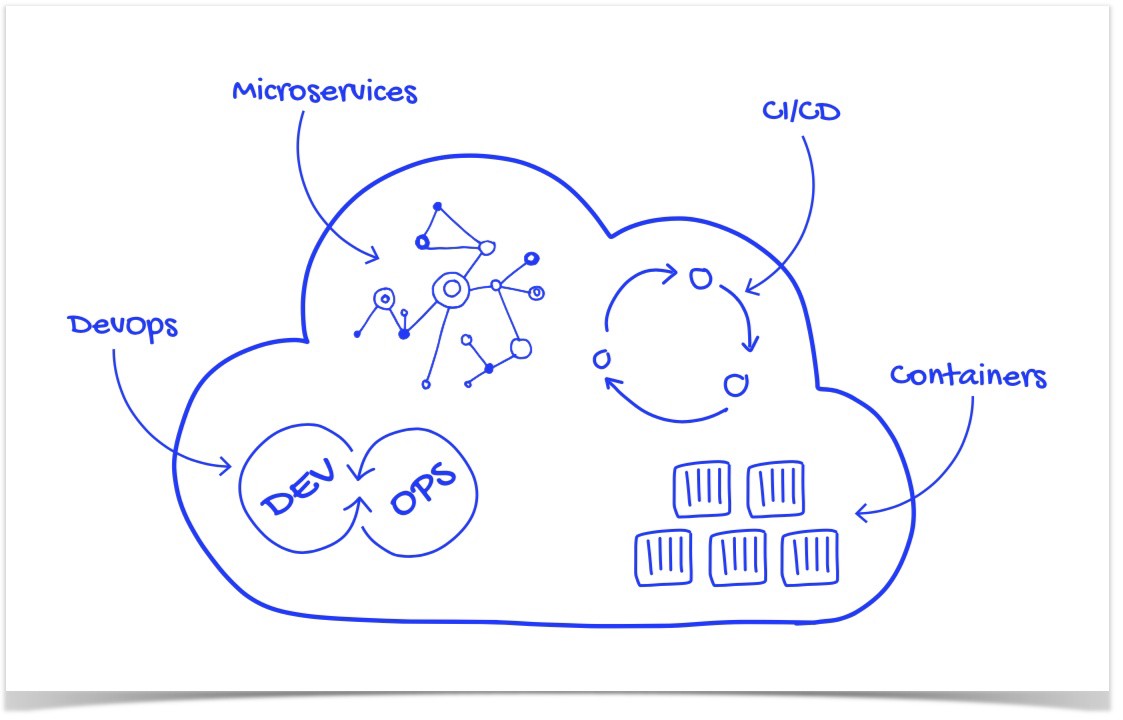
Introduction
Cloud-Native Applications in Practice are composed of smaller, independent, and loosely coupled services. They are designed to deliver undeniable business value, such as the ability to quickly incorporate user feedback for continuous improvement. In other words, cloud-native development accelerates the creation of new applications, optimizes legacy ones, and connects them effectively. The goal is twofold: to provide users with the applications they need while keeping pace with the demands of their business activities.
When we say an application is “cloud-native,” it means it has been designed to offer a consistent development and automated management experience across private, public, and hybrid clouds. Businesses adopt cloud computing to enhance scalability and availability through self-service provisioning, on-demand resources, and lifecycle automation from development to production.
This article, titled Cloud-Native Applications in Practice, explores essential criteria, presents tools for each step, and offers a practical methodology to achieve the transformation of legacy applications into cloud-native systems.
Criteria for a Cloud-Native Application
1. Microservices Architecture
- Description: The application is divided into independent and loosely coupled services, each handling a specific business function.
- Advantages: Enhanced scalability, faster updates, and easier maintenance.
- Tools: Kubernetes, Istio (service mesh).
2. Containerization
- Description: Applications are packaged with their dependencies into containers to ensure portability and consistency.
- Advantages: Simplified deployment across environments.
- Tools: Docker, Podman.
3. Automation (CI/CD)
- Description: Continuous integration and delivery pipelines automate testing, deployment, and updates.
- Advantages: Faster and more reliable software delivery.
- Tools: Jenkins, GitLab CI/CD, ArgoCD.
4. Observability
- Description: Includes monitoring, logging, and tracing to provide insights into system health and performance.
- Advantages: Proactive issue detection and resolution.
- Tools: Prometheus, Grafana, OpenTelemetry.
5. Resilience and Scalability
- Description: Fault-tolerant systems that dynamically scale to meet demand.
- Advantages: High availability and adaptability.
- Tools: Kubernetes Horizontal Pod Autoscaler (HPA), Chaos Monkey.
6. Cloud-Native Storage and Databases
- Description: Optimized storage solutions that integrate seamlessly with cloud environments.
- Advantages: Reliability and performance.
- Tools: PostgreSQL with Kubernetes Operators, Amazon Aurora.
Cloud-Native Tools for Each Stage
| Stage | Tools | Description |
|---|---|---|
| Development | Visual Studio Code, Skaffold | Streamlines local development cycles. |
| Testing | Postman, k6 | Ensures API functionality and performance. |
| Containerization | Docker, Podman | Prepares applications for deployment. |
| Orchestration | Kubernetes | Manages and scales containerized applications. |
| Monitoring | Prometheus, Grafana | Tracks system metrics and health. |
| Deployment | Helm, ArgoCD | Simplifies application deployment and updates. |
Transforming a Legacy Application to Cloud-Native
1. Architecture Analysis
- Objective: Assess monolithic application components and dependencies.
- Action: Split the monolith into functional services. For example, separate authentication, payment processing, and user management.
2. Containerization
- Backend: Create a
Dockerfilefor the Java monolith (e.g., Spring Boot).FROM openjdk:17
WORKDIR /app
COPY target/monolithic-app.jar /app/app.jar
ENTRYPOINT ["java", "-jar", "/app/app.jar"]
3. Transition to Microservices
Identify business-critical modules within the monolith.
Example: If the monolith includes authentication, order processing, and billing, transform them into independent services.
Practical Example: Create a REST API for each service. For instance, a Spring Boot authentication API:
@RestController
@RequestMapping("/api/auth")
public class AuthController {
    @PostMapping("/login")
    public ResponseEntity<?> login(@RequestBody LoginRequest request) {
        // Authentication logic
        return ResponseEntity.ok("Login success");
    }
}
4. Deploy Microservices
- Create Dockerfiles for each service and deploy them using Kubernetes manifests.
- Example Kubernetes deployment YAML:
apiVersion: apps/v1
kind: Deployment
metadata:
  name: auth-service
spec:
  replicas: 2
  selector:
    matchLabels:
      app: auth
  template:
    metadata:
      labels:
        app: auth
    spec:
      containers:
      - name: auth-service
        image: myregistry/auth-service:1.0
        ports:
        - containerPort: 8081
5. CI/CD Integration
- Example Pipeline: Automate builds and deployments with GitLab:
stages:
  - build
  - deploy

build-job:
  stage: build
  script:
    - mvn clean package
    - docker build -t myregistry/auth-service:latest .
    - docker push myregistry/auth-service:latest

deploy-job:
  stage: deploy
  script:
    - kubectl apply -f k8s/auth-service-deployment.yaml
6. Observability Setup
- Configure dashboards in Grafana to monitor microservices performance.
- Example: Set alerts for API response times exceeding thresholds.
Conclusion
The development of Cloud-Native Applications in Practice is not just a trend but a vital strategy for businesses aiming to accelerate innovation. By embracing microservices, containerization, and automation, organizations can create responsive, scalable, and fault-tolerant systems. Whether optimizing existing applications or building new ones, the cloud-native approach ensures agility and quality in a rapidly evolving market. Start small, experiment, and transform your architecture to unlock the full potential of the cloud.